

44.5K
Downloads
323
Episodes
Austroads latest webinars. Sharing transport research and trends.
Episodes

May 14, 2026
May 14, 2026
1hr 1 min
This webinar provided an overview of the Austroads’ report, Keeping People Safe When Walking – Stream 2: Economic Assessment of Safer Speeds, completed as part of the Keeping People Safe When Walking program. The assessment applies a cost-benefit analysis (CBA) approach, which estimates and compares the costs and benefits for society from 12 different hypothetical speed limit reductions in a variety of (mostly urban) contexts. Emerging economic techniques were applied to value, in dollar terms, the benefits of reduced speed limits for society from reduced road trauma and improved pedestrian mobility. This was weighed against productivity-related costs from increased travel time. The assessment builds a framework and evidence to support road managers looking to assess speed limit changes.
In this webinar, attendees heard about:
- how speed limit reductions can be assessed using a cost-benefit analysis framework
- why it appears there is a strong case for safer speed limits as a key pedestrian safety intervention
- the key drivers of this result and areas where further evidence would add value for future policy reform assessments.
This webinar was presented by Anna Wilson. The Q+A was moderated by Phil Harbutt.

May 1, 2026
May 1, 2026
1hr 1 min
This webinar introduces the Travel to School Guideline, developed to support the planning and delivery
of safe, active travel for students.
The guideline promotes integrated, evidence-based approaches that prioritise children’s mobility, health,
and safety within transport and land-use planning.
It provides a practical framework for planning both new and existing schools, drawing on best-practice principles, policy guidance, and implementation tools suitable for a range of school environments.
During the webinar, we explore key elements of the guideline, including:
* Integrated planning – coordinating land use, school siting, and transport infrastructure to reduce reliance on car travel.
* Collaboration – working across government, schools, and communities to achieve successful outcomes.
* Integrated solutions – combining infrastructure improvements with travel behaviour change initiatives.
* Community-informed planning– a model to ensure local knowledge shapes context-appropriate solutions.
* Case studies, tools, and resources to support implementation and evaluation.
The guideline is supported by two research reports covering the principles and best-practice evidence behind the guidance
Mar 31, 2025
Mar 31, 2025
56 min
This webinar introduced the new Austroads Guidance for Cycling and Micromobility Planning, a resource for professionals seeking to deliver safer outcomes for all road users. The project aimed to deliver a consolidated and nationally consistent approach to cycling and micromobility planning and includes recommended changes to the Austroads Guide to Traffic Management.
The webinar shared the key themes that emerged from research and consultation. It introduced the three overarching recommendations of the Guidance: providing stronger links to best-practice cycle planning and design principles; recognising that considered terminology can help deliver projects; and updating the AGTM's scope to include wider micromobility options. Recommendations are supported with practical tools and strategies to facilitate better cycling and micromobility planning outcomes. The webinar was presented by Clare Huggins and James Laing, and moderated by Mary Haverland.
Jul 24, 2024
Jul 24, 2024
1hr 8 min
This is the final webinar in the three-part webinar series to present the outcomes of the Austroads project “Prioritising Active Transport”.
Presenters Dr Elliot Fishman and Andrew Somers focus on various policies and other non-infrastructure interventions that can be used to increase levels of active travel. These interventions include measures such as speed reduction, policies to integrate public transport with walking and cycling, pricing measures for motor vehicle use and parking and shared micromobility programs.
The session also covers how policy and other non-infrastructure interventions perform in terms of their impact on growing active transport mode share, in comparison to the cost and complexity of implementing these initiatives.

Jul 11, 2024
Jul 11, 2024
1hr 1 min
Cities throughout the world are recognising many public spaces are not welcoming or inclusive, particularly for women, girls, gender diverse groups and vulnerable people.
This webinar, presented by Anna Chauvel and Richmond Henty, focuses on Canberra's first Gender Sensitive Urban Design Guidelines. The guidelines will help planners, engineers, architects, landscape designers and developers create urban spaces that reflect the needs, interests, and routines of the city’s diverse community, enriching people’s daily lives.
Developed following over two years of community and stakeholder engagement, the guidelines will aid with the design and delivery of public urban spaces as well as transport and infrastructure projects, including wayfinding. The guidelines are one of the actions to come out of the Second Action Plan 2020-22 of the ACT Women’s Plan.
The guidelines will deliver practical outcomes to the daily lives of women, girls, gender diverse and vulnerable people in Canberra improving their safety, access, mobility, health, and enjoyment in public spaces.

Jul 9, 2024
Jul 9, 2024
1hr 18 sec
Safety is often the first thing that comes to mind when thinking about transport and city planning from a gender perspective, but feeling safe should be the baseline, not the benchmark when it comes to inclusive cities.
From Barcelona’s Superblocks to women’s cycling rates in Copenhagen, through to building women’s autonomy into the business case, this webinar’s presenter Estelle Grech shares key insights from her Churchill Fellowship where she travelled to 14 cities around the globe to research how to design cities for women in girls.
Nov 9, 2023
Nov 9, 2023
1hr 4 min
Austroads has developed an extended vehicle classification scheme (EVCS) to enable improved understanding and monitoring of the evolving vehicle mix on Australian and New Zealand roads in traffic and transport surveys. This builds upon the existing 1994 vehicle classification scheme.
The EVCS provides greater granularity for each of the existing 12 classes of vehicles and adds a new class for active transport to address the need to count a variety of active transport users such as pedestrians, skateboards and e-scooters.
The EVCS will allow transport agencies to better manage transport demand within and between modes, survey active transport and understand how demands integrate with other modes.
The scheme will help identify changes in transport operational performance and optimise plans for effective access management and asset maintenance.
This webinar is the third session in a three-webinar series, and it will focus on measuring active transport. The first webinar covered heavy vehicles and the third session discussed the changes to light vehicles.
This webinar, presented by Drew Gaynor and David Johnston, focuses on active transport and discusses:
- the creation of level 3 class 20
- the greater granularity in level 4 subclasses
- emerging challenges in categorising class 20 elements
- the use of alternative counting technologies.
Nov 2, 2023
Nov 2, 2023
1hr 1 min
Austroads has developed an extended vehicle classification scheme (EVCS) to enable improved understanding and monitoring of the evolving vehicle mix on Australian and New Zealand roads in traffic and transport surveys. This builds upon the existing 1994 vehicle classification scheme.
The EVCS provides greater granularity for each of the existing 12 classes of vehicles and adds a new class for active transport to address the need to count a variety of active transport users such as pedestrians, skateboards and e-scooters.
The EVCS will allow transport agencies to better manage transport demand within and between modes, survey active transport and understand how demands integrate with other modes.
The scheme will help identify changes in transport operational performance and optimise plans for effective access management and asset maintenance.
This webinar, presented by Drew Gaynor and David Johnston, is the second session in a three-webinar series, and it focuses on the changes to light vehicles. The first webinar covered heavy vehicles and the third session will provide information on measuring active transport.
This webinar discusses:
- level 3 classes 1 and 2
- the greater granularity in level 4 subclasses
- thresholds between classes 2 and 3
- the use of alternative counting technologies.
Oct 25, 2023
Oct 25, 2023
1hr 4 sec
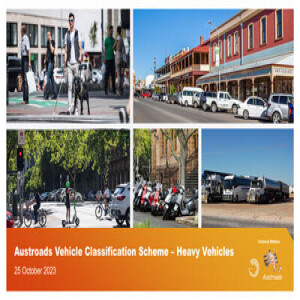
Austroads has developed an extended vehicle classification scheme (EVCS) to enable improved understanding and monitoring of the evolving vehicle mix on Australian and New Zealand roads in traffic and transport surveys. This builds upon the existing 1994 vehicle classification scheme.
The EVCS provides greater granularity for each of the existing 12 classes of vehicles and adds a new class for active transport to address the need to count a variety of active transport users such as pedestrians, skateboards and e-scooters.
The EVCS will allow transport agencies to better manage transport demand within and between modes, survey active transport and understand how demands integrate with other modes.
The scheme will help identify changes in transport operational performance and optimise plans for effective access management and asset maintenance.
This webinar, presented by Drew Gaynor and David Johnston, is the first session in a three-webinar series, and it focuses on the changes to heavy vehicles. The second webinar will cover light vehicles and the third session will provide information on measuring active transport.
This webinar discusses:
- level 3 classes 3 to 12
- the greater granularity in level 4 subclasses
- better description of axle groupings
- the creation of a new class 19 for heavy vehicles that do not fit readily into the prescribed classifications
- backward compatibility with existing heavy vehicles counting
- further validation of some sections.
May 25, 2023
May 25, 2023
1hr 2 min
This webinar is beneficial to consultants who may be interested in tendering for Austroads projects. The session covers new Austroads projects lined up for the 2023-24 financial year, Austroads process around research data collection and what is required to become a successful tenderer.
To find information about Austroads' current tenders, visit the tenders webpage. On that page, you can also subscribe to our Tenders newsletter to receive alerts when a new project is advertised.